The geological significance of the Appalachian-Caledonian Orogen on the island of Newfoundland has been extensively documented. Early work on geology was carried out in the 19th century by British-born geologists Joseph Jukes and Alexander Murray, first director of the Geological Survey of Newfoundland. Famed Mi’kmaq mapper and prospector Mattie Mitchell discovered the huge Buchans orebody in central Newfoundland in 1905, leading to increased interest in exploration throughout the province. Mitchell lived in the Geopark and was buried in Corner Brook. Yale paleontologists Charles Schuchert and Carl Dunbar did foundational stratigraphic work in the early 20th century.
For more than a century, geologists viewed the continents with their mountain belts as geographically fixed regions. Geologists proposed that deep troughs, called geosynclines, spontaneously developed throughout Earth’s history and were later subjected to deformation, metamorphism, and plutonism to create mountains; however, a convincing explanation for the upheavals proved elusive. Recognition and acceptance of continental drift and the development of plate tectonics in the 1960s provided a new understanding. The development of orogenic belts is now understood to be the result of a cycle of continental rifting, ocean-floor spreading, and subduction, leading to the accretion of exotic terranes to continental margins and eventual continental collision.
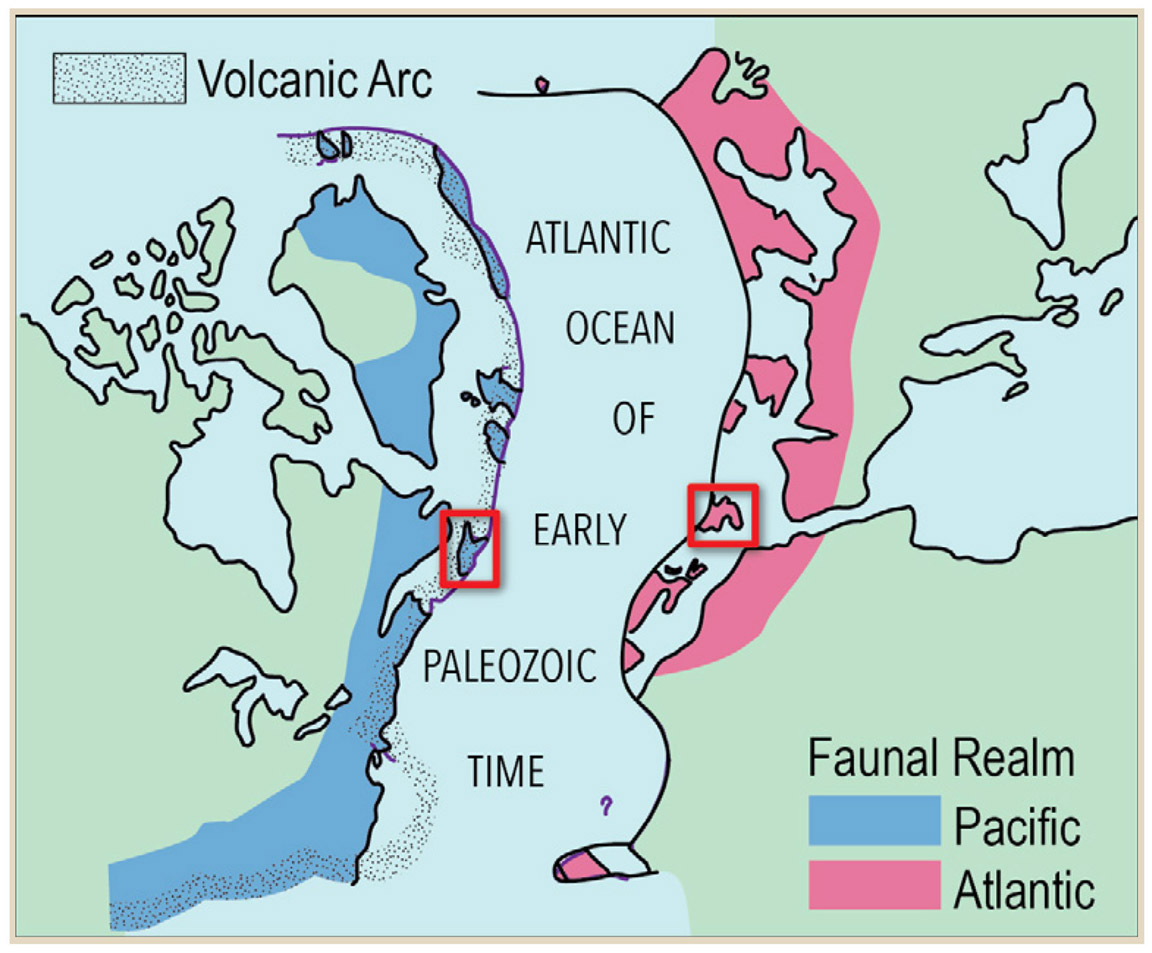
In 1963 John Rodgers, another Yale geologist and expert on the Appalachian orogen, collaborated with Ward Neale of Memorial University of Newfoundland in proposing a tectonically transported allochthon in the Bay of Islands region. In the 1960s, the unique character of the Bay of Islands Ophiolite was first appreciated by MUN geologist Bob Stevens, who identified chromite grains derived from the ophiolite in the sandstones tectonically beneath it. In 1966, Canadian geophysicist J. Tuzo Wilson, a pioneer of the theory of plate tectonics, published a paper entitled “Did the Atlantic close and then reopen?,” in which he identified a “suture,” the site of a closed ocean, through central Newfoundland, and showed that the mountains of Ireland and Scotland were separated from those in Newfoundland by the opening of the much younger Atlantic Ocean.
Tuzo Wilson’s 1966 Map, Modified from Wilson, J.T., 1966. Did the Atlantic close and then re-open? Nature 211, 676-681
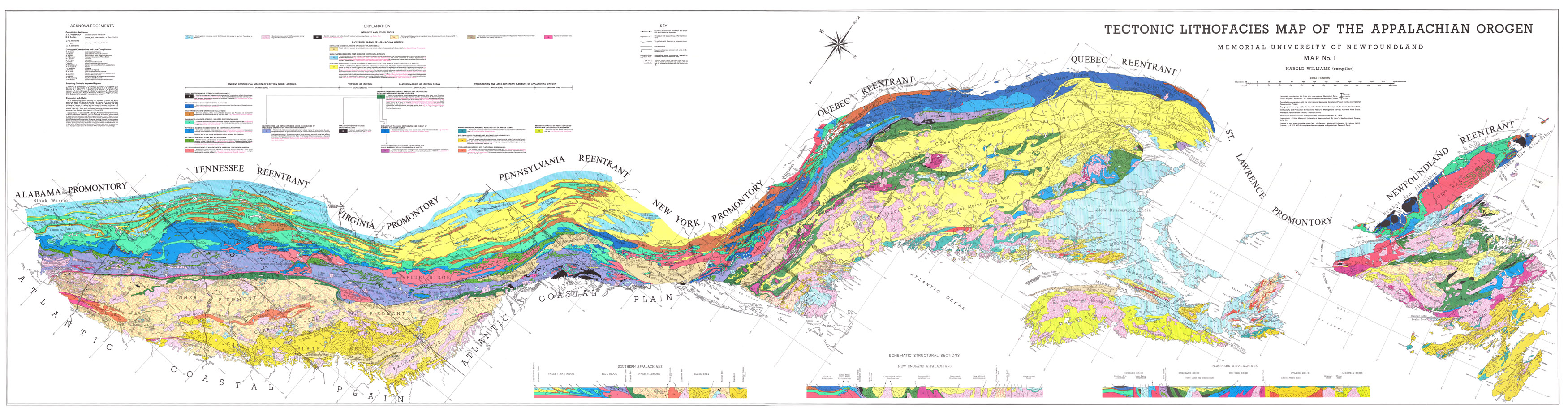
Renowned Newfoundland-born geologist Harold (Hank) Williams synthesized the island’s geology in a series of papers from 1964 onwards, culminating in the publication of an influential map of the entire Appalachian orogen in 1978. In this map, the zones named in Newfoundland were extended through the orogen to Alabama in the southeastern United States. Willams’ work, together with that of his contemporaries, is summarized in the 1995 volume Geology of the Appalachian Orogen in Canada and Greenland, which was published by the Geological Survey of Canada and edited by Williams.
Hank William’s Tectonic Lithofacies Map of the Appalachian Orogen, 1978
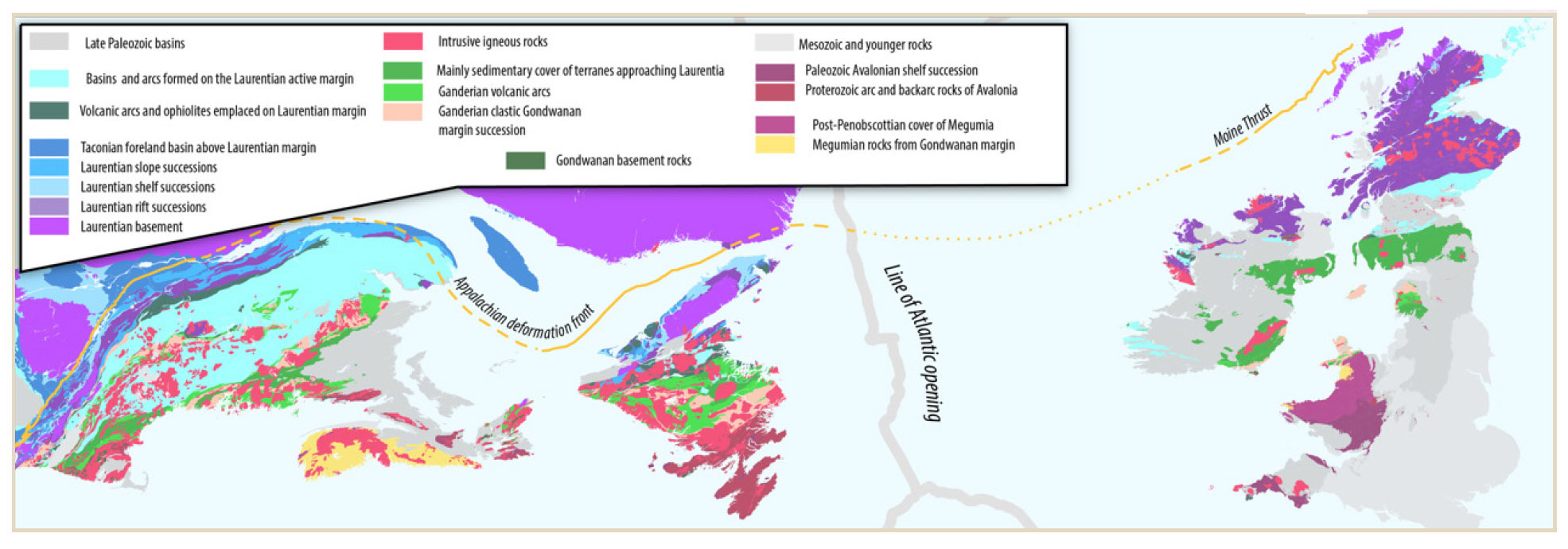
The Canadian Appalachian region includes insular Newfoundland; the provinces of Nova Scotia, New Brunswick and Prince Edward Island; and southern Québec. These areas form part of a vast belt of deformed rocks that extends southward through the eastern United States as far as Alabama and continues to the east across the Atlantic Ocean into the Caledonian mountains of Ireland, Britain, and Scandinavia. This belt is known as the Appalachian–Caledonian mountain belt or orogen, for which Newfoundland is widely regarded as a “type area,” underscoring its global importance. Orogens are belts affected by long-lived folding, faulting, metamorphism, and igneous activity. They are now understood to form as a result of plate convergence. The striking geological parallels between Newfoundland, Ireland, and the United Kingdom were instrumental in confirming the original continuity of this orogen, providing a critical piece of evidence in the validation of the theory of plate tectonics.
Tectonic map of the Northern Appalachians and the Caledonides of Ireland and Britain, showing the Appalachian–Caledonide orogen as it existed prior to the opening of the Atlantic Ocean. Modified from Waldron et al. 2022, Earth-Science Reviews 233, 104163
The development of the Appalachian–Caledonian Orogen records a significant interval in Earth’s history, spanning the Neoproterozoic to Paleozoic eras. This orogen evolved through the sequential collision of continental blocks representing Laurentia (ancestral North America), Baltica, and Gondwana, together with numerous microcontinental fragments and volcanic arcs, culminating in the assembly of Pangea, one of Earth’s major supercontinents. The orogen records the formation and destruction of two oceans that were precursors to the modern Atlantic: the Iapetus and Rheic oceans.
The Appalachian–Caledonian Orogen has been particularly significant in the history of Earth science, as its European section was the birthplace of modern geology in the 18th century, beginning with James Hutton’s work in Scotland. By the 20th century, the Canadian segment—notably Newfoundland—became central to the scientific revolution that led to the acceptance of plate tectonics. The region’s geological exposures allowed for a first application of plate-tectonic models to orogens, providing critical evidence for processes such as continental collision, terrane accretion and oceanic-basin closure. Newfoundland emerged as a “laboratory” for geoscientific innovation.